
Why I’m Choosing to Give Thanks in 2026
Every January I choose a word or phrase to focus on for the coming year. Focusing on one thing that I would like to cultivate has been immeasurably helpful for me. I used to make New Year’s resolutions, but by mid-January they were stuck in a notebook or drawer, a reminder of how I was failing.
I rarely feel like I’ve done a stellar job living out the word I’ve chosen, but the process has been so helpful that I choose a different word every year. This year, it’s “Give Thanks.”
Why “Give Thanks” Felt Risky
Every fall, I start jotting down words or phrases that keep surfacing—things that resonate as I hear or read them. I keep a running list, and in late December I prayerfully consider what I’ve written, asking God for wisdom.
In November, I began reading Sunday Evenings with Joni and was struck by the fact that Joni had a mission statement for her life. As I reflected on what my own mission statement might be, the verse “Give thanks to the Lord, for he is good, for his steadfast love endures forever” (Psalm 107:1) came to mind. I immediately pushed it away.
I love that passage, and it is one of the memory verses in my devotional Watching for the Morning. It’s important to give thanks in trials, recognizing that God is good and loving. Yet at times, seeing the positives in a situation feels trite. Even in the devotional, I say, “I’m not a proponent of the “count your blessings” cliché—forcing people to be cheerful when things are painful.” So honestly, considering that verse as a potential mission statement made me feel that I’d need to pretend I was happy when I wasn’t.
Still, I couldn’t shake it. So instead of committing fully to it (clearly I’m not ready for that), I decided to make it my word for the year.
Though I chose my word with trepidation, now I see how it’s already changing me.
How Giving Thanks Is Changing Me
Several days ago, I was recording the audio version of my next book when my voice began to give out on the first day.
The engineer told me to go home, hydrate, rest my voice, and return the next day. We had recorded only about a third of what I needed, and with just two days scheduled, I had already used one.
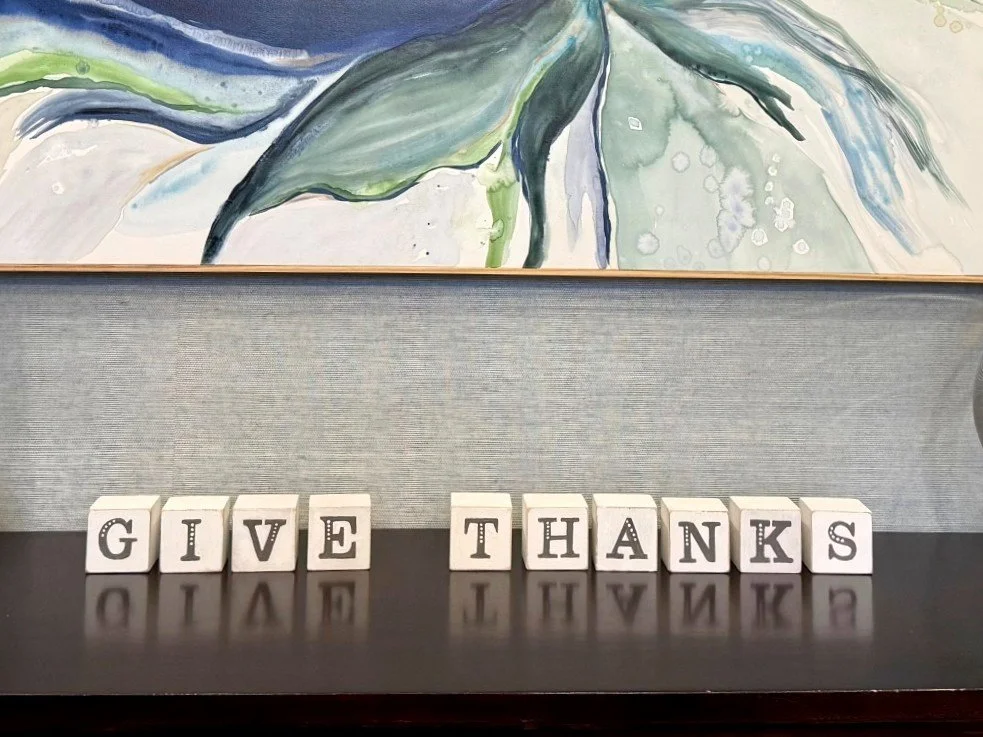
I went home exhausted. My voice felt weak, and I was convinced I wouldn’t be able to finish. But as I glanced at my word for the year, spelled out in blocks on my table, I began to thank God.
I thanked him that whatever happened, he was in it. If I finished the recording, it would only be by his strength, knowing that his power is made perfect in weakness. And if I couldn’t finish, perhaps God had another reader in mind. Perhaps pushing my voice would cause permanent damage. Perhaps I would never know the reason, but I could trust that there was one.
With that realization, peace settled over me. I stopped carrying responsibility for something I couldn’t control. I tend to do that—to carry my limitations as though they’re mine to fix. But that night, as I embraced my finitude and God’s goodness, I rested. I went to bed thanking God in advance for whatever happened.
The next day, I was able to finish the entire recording. My voice was stronger than the day before, even though I woke up feeling weaker. I give all the glory to God for that miracle. But the greater miracle to me was being able to release the outcome to God and trust that whatever happened would be for my good.
Giving Thanks and Knowing God Are Intertwined
As I studied my phrase more closely, I learned that “give thanks” comes from a single Hebrew word, yadah (יָדָה), which is often translated as “to give thanks” but literally means to throw or to cast.
I realized that when we give thanks, we are casting our burdens on God, entrusting him with the outcome, confident that he cares for us. Gratitude isn’t limited to what feels good or makes sense. When we believe that God has already been to tomorrow and is giving us exactly what we need for today, we can rest and be thankful.
The word yadah is closely related to another Hebrew word, yada (יָדַע), which means to know. This is a deep, experiential, relational knowing, not merely head knowledge.
In Exodus 33:13, Moses prays, “Please show me now your ways, that I may know you.” To know God, Moses needed to see his ways, so he would know God’s character, his faithfulness, his heart.
Only when we know God from experience, only if we’ve met him, can we truly give thanks in all circumstances. Then we trust him because we’ve seen his goodness. We believe his steadfast love endures because we’ve felt it. And because of that, we can give thanks—even when the outcome is unknown, even when the present feels impossibly heavy, even in the middle of the mess.
Gratitude Before the Outcome
I’ve seen people choose to give thanks even when the outcome was uncertain and the circumstances were devastating. For some, they understood why it happened. For others, God changed their situations. And still for others, it drew them closer to God, giving them joy and hope in him.
In The Hiding Place, Corrie ten Boom tells how her sister Betsy gave thanks even for the fleas in their concentration camp barracks—something Corrie thought went too far. But later they realized the fleas kept the guards away, allowing them to hold Bible studies undisturbed. Unbeknownst to them, God was doing something eternally significant that they couldn’t have known when they gave thanks.
In 2 Chronicles 20, when King Jehoshaphat learned his enemies were approaching, after prayer he appointed singers to go before the army, proclaiming, “Give thanks to the Lord, for his steadfast love endures forever.” The Lord then set an ambush for their enemies who annihilated each other in battle. The Israelites praised and thanked the Lord, and he did the rest.
Habakkuk 3:17-18 gives us a beautiful picture of thankfulness in trial. Even when all the fields were barren and the livestock were gone, the prophet rejoiced in God. That meant no food, no future, no security. Maybe famine and ruin. Habakkuk had no idea how long this devastation would last or how it would end, but he knew whose hands it was in. And that was enough for him to rejoice.
An Invitation
As I move into 2026, I want “Give Thanks” to be less about how I feel and more about whom I trust. Not gratitude that waits for answers, but gratitude that rests in God’s character.
I don’t know how this year will unfold. But I do know the One who has already been there.
Maybe for you, gratitude feels complicated too. Maybe it feels premature, costly, or even risky. If so, perhaps gratitude isn’t something to voice after you know the outcome but is a way of placing what you can’t control into the hands of a God you know is infinitely good.
Noticing what you need is often where a word for the year begins.
I’m wondering, do you have a word for the year? If you do, I’d love to hear about it in the comments.